
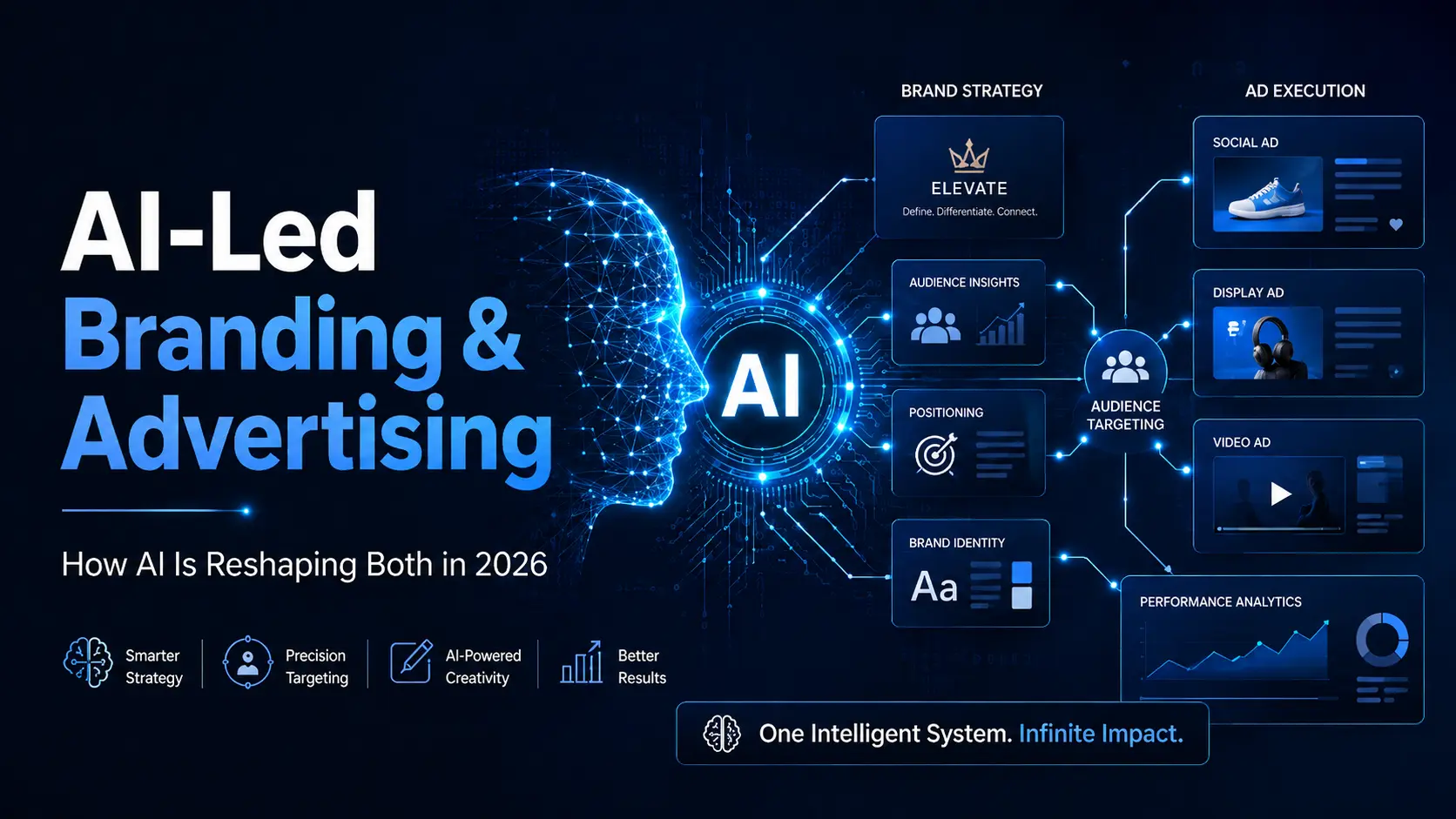

AI-Led Branding & Advertising: How Artificial Intelligence Is Reshaping Both, Together
For years, branding and advertising were treated as two different disciplines running on two different clocks. Branding was slow, deliberate, and strategic — a logo, a tone of voice, a positioning statement revisited once every few years. Advertising was fast, tactical, and constantly optimized — new creative, new targeting, new bids, every single day.
AI has quietly collapsed that separation. The same intelligence layer that decides which ad to show a user in real time is now also shaping how brands define their identity, adapt their tone, and stay recognizable across every platform. This is AI-led branding and advertising: brand strategy and ad execution increasingly running on the same AI-driven system, informing each other in real time instead of operating on separate timelines.
Here's what that actually looks like, and what it means for how brands need to build and market themselves in 2026.
Why Branding and Advertising Are Converging Under AI
Brand strategy in 2026 has to respond to a new reality: AI increasingly mediates how people discover and choose brands in the first place, whether through a Google AI Overview, a ChatGPT recommendation, or an ad algorithm deciding who sees your message at all. That means a brand's identity can no longer live only in a style guide — it has to be consistent, adaptable, and legible enough for AI systems to recognize and represent accurately, everywhere those systems operate.
At the same time, advertising has become too fast and too granular for a static brand identity to keep up with manually. When an AI system can generate and test thousands of ad variations a day, someone — or something — has to keep every one of those variations recognizably "on brand." That's the exact intersection where AI-led branding and AI-led advertising now meet.
How AI Is Changing Branding
AI-assisted visual identity, still human-refined
Design platforms can now generate large numbers of logo and visual identity variations in minutes, letting creative teams focus on refining strong directions instead of starting from a blank page. Importantly, this hasn't eliminated the need for human judgment — if anything, audiences have grown more sensitive to generic, obviously AI-generated visuals, which is pushing brands back toward hand-crafted detail and imperfection as a signal of authenticity.
Brand voice trained and maintained by AI
AI tools can now train on a brand's existing tone and messaging, then generate new copy — social captions, ad copy, email subject lines — that stays consistent with that voice across an enormous volume of content. This solves one of branding's oldest problems: voice drift, where messaging slowly becomes inconsistent as more people and more channels get involved.
Real-time brand sentiment monitoring
AI-powered social listening tools now track brand perception continuously, identifying emotional tone shifts in conversations as they happen rather than waiting for a quarterly brand health survey. This turns brand management from a periodic check-in into an ongoing, responsive practice.
Brand authority as an AI-search ranking signal
This is the part most brands haven't caught up to yet: AI-powered search and recommendation systems don't just look for keywords, they look for entities they can trust. A brand with strong, consistent identity signals — clear expertise, authoritative content, recognizable positioning — is more likely to be the brand an AI system actually recommends. In other words, strong branding is quietly becoming a ranking factor in the AI-search era, not just a trust-building exercise.
How AI Is Changing Advertising
AI-driven targeting and bidding
Deep learning models now evaluate hundreds of real-time signals and adjust ad bids automatically, spending more on high-probability converters and less everywhere else. This impression-level decisioning has replaced static, rule-based bidding almost entirely on major ad platforms.
Generative, modular creative at scale
Instead of a handful of manually built ad versions, AI systems now assemble thousands of creative combinations from modular components — different headlines, visuals, and calls to action — adapting in real time to context like time of day or device.
Predictive attribution
AI-driven attribution models are replacing older, rule-based multi-touch attribution, more accurately identifying which touchpoints actually influenced a conversion — which directly improves how confidently a brand can allocate budget.
Where They Meet: The AI-Led Brand-to-Ad Pipeline
Here's the practical shift for any business advertising today: your brand identity is no longer just the input a creative team references before building an ad campaign. It's becoming a live data set that AI systems draw from directly — training tone-of-voice models, informing which modular ad components "sound like you," and shaping how consistently your identity holds up across thousands of AI-generated variations running simultaneously.
This means a business with a vague, undocumented brand identity is now at a structural disadvantage in advertising, not just in design. AI can't stay consistent with a brand voice that was never clearly defined in the first place. The businesses seeing the strongest results are the ones treating brand strategy and ad execution as a single connected system, not two separate projects handed to two separate teams.
What This Means for Your Business
| # | Recommendation |
|---|---|
| 1 | Document your brand identity properly, in writing — tone, values, visual rules, messaging pillars. AI copywriting and creative tools are only as consistent as the brand guidelines they're trained on. |
| 2 | Treat brand consistency as an AI-search ranking factor, not just a design preference — clear, authoritative branding increasingly determines whether AI systems recommend you at all. |
| 3 | Build modular creative assets so your ad campaigns can scale with AI-driven testing without losing brand consistency across thousands of variations. |
| 4 | Keep a human reviewing AI-generated brand and ad output — both for quality and because audiences are increasingly fatigued by generic, obviously AI-made content. |
| 5 | Monitor brand sentiment continuously, not periodically, using AI-powered listening tools, since perception can now shift and spread faster than a quarterly review cycle can catch. |
The Bottom Line
Branding and advertising used to run on different clocks. AI has forced them onto the same one. A brand that's clearly defined, consistently documented, and genuinely authoritative doesn't just look better — it performs better, because the same AI systems increasingly deciding what to advertise and what to recommend are both, ultimately, looking for the same thing: a brand they can recognize and trust.
Frequently Asked Questions
What is AI-led branding and advertising?
AI-led branding and advertising describes how artificial intelligence now drives both brand strategy (visual identity, tone of voice, brand monitoring) and ad execution (targeting, bidding, creative generation) as one connected, AI-powered system rather than two separate disciplines.
Does AI replace the need for a branding agency?
No. AI accelerates and scales branding work like logo variations, tone-consistent copywriting, and sentiment tracking, but strategic positioning, creative judgment, and brand direction still require human expertise, especially since audiences are growing more sensitive to generic AI output.
How does branding affect visibility in AI search tools like ChatGPT?
AI search and recommendation systems favor brands that demonstrate clear authority and trustworthiness. A well-documented, consistent brand identity makes it easier for these systems to recognize and confidently recommend a business.
Can small businesses use AI-led branding and advertising, or is it only for big brands?
Small businesses can use it, often more easily than large ones, since AI tools have lowered the cost of professional-quality design, copywriting, and ad testing that used to require large in-house teams.
What's the biggest mistake businesses make with AI-led branding and advertising?
Using AI tools without a clearly documented brand identity first. AI can scale a brand's voice and visuals consistently, but only if that identity was defined clearly in the first place — otherwise AI just scales inconsistency faster.