
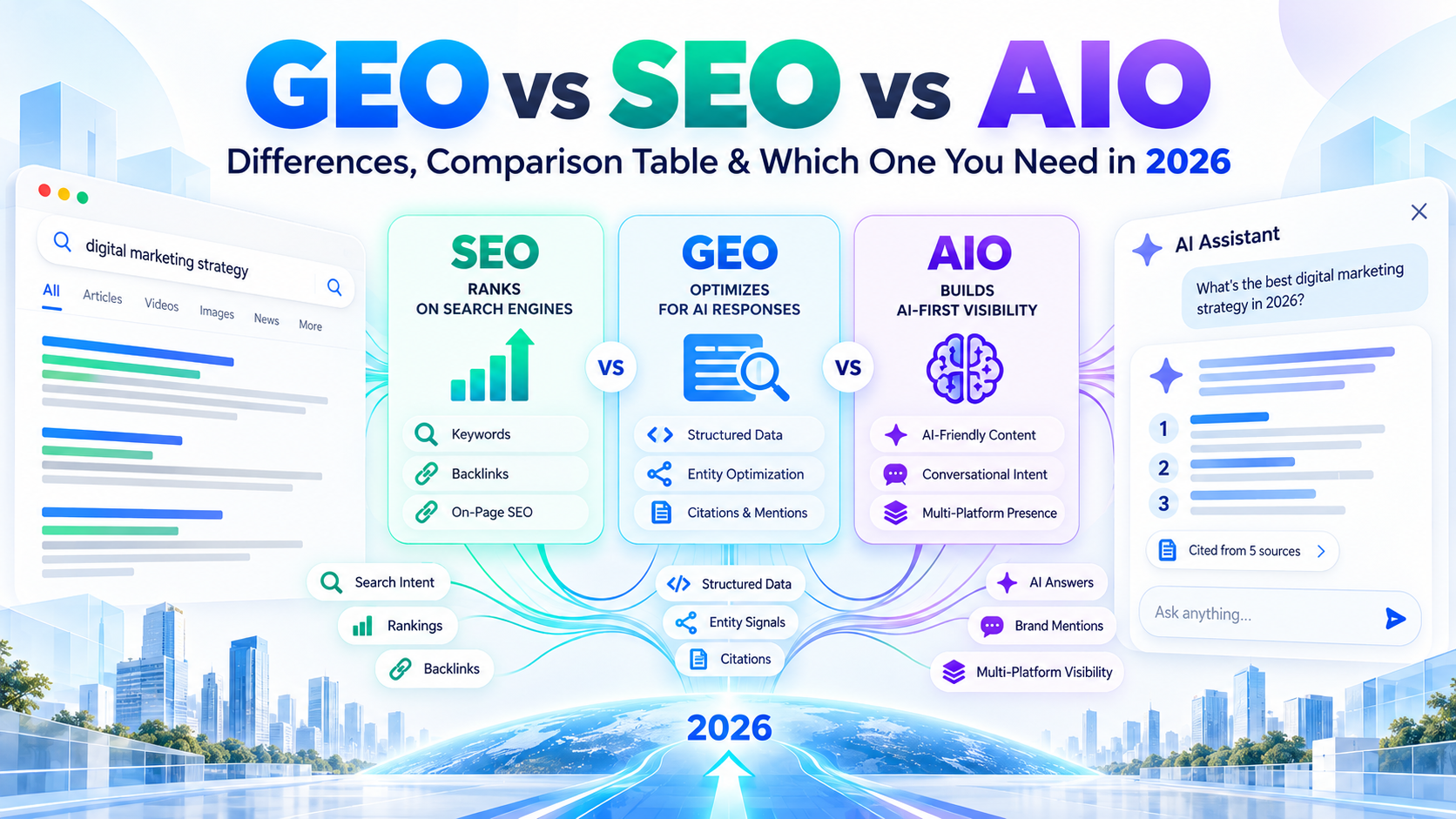

GEO vs SEO vs AIO: Differences, Comparison Table and Which One You Need in 2026
By Edigigo Team | Published: 11 Oct 2026 | Updated: 11 Oct 2026
Search is splitting in two. People still use Google, but they also ask ChatGPT, Gemini and Perplexity for recommendations, and they see AI-written answers above the usual results. That has created new terms: SEO, GEO and AIO. This guide explains what each one means, how they differ, how they overlap, and which one your business should prioritise.
What Is SEO?
SEO (Search Engine Optimization) improves your website so it ranks higher in results on Google and Bing. It covers technical health, on-page optimization, quality content and backlinks. The outcome is clicks: users see a list of links and choose one.
What Is GEO (Generative Engine Optimization)?
GEO improves the chances that your brand, content or data is cited or recommended inside AI-generated answers on tools like ChatGPT, Gemini, Perplexity and Google's AI Overviews. The outcome is a mention: the user may never visit a results page, so being named in the answer is the win. For a practical walkthrough, read how to get your brand recommended by ChatGPT, Gemini and Perplexity.
What Is AIO (AI Optimization)?
AIO is a broader, less standardised label. Most agencies use it to mean AI Optimization: making your brand, content, data and workflows work well across AI-driven search and answer experiences. Some people use "AIO" to refer to Google AI Overviews specifically. Because the term isn't used consistently, ask any vendor how they define it. In practice, GEO and AIO overlap heavily, and at Edigigo we group them as GEO/AIO.
You may also see AEO (Answer Engine Optimization), which focuses on being the direct answer in featured snippets, voice assistants and answer boxes. It sits alongside GEO and AIO.
GEO vs SEO vs AIO: Comparison Table
| Factor | SEO | GEO | AIO |
|---|---|---|---|
| Primary goal | Rank pages and earn clicks | Get cited or recommended in AI answers | Be understood and trusted across AI-driven search |
| Where you appear | Google and Bing result pages | ChatGPT, Gemini, Perplexity, AI Overviews | AI answers, assistants and AI-enhanced search |
| Core tactics | Keywords, technical SEO, links, content | Answer-first content, entities, citations, third-party mentions | Structured data, entity clarity, AI-readable content and data |
| Main metrics | Rankings, organic traffic, conversions | Mentions, citations, recommendations in prompts | AI visibility, accuracy of brand descriptions, referral traffic |
| Content style | Keyword-targeted pages | Direct answers, FAQs, tables, original data | Clear, consistent, machine-readable information |
| Time to results | About 3 to 6 months | About 3 to 6 months | About 3 to 6 months |
Timelines are typical ranges, not guarantees, and vary by industry and competition.
How They Overlap
- Quality content: all three reward accurate, helpful, original content
- Technical health: a crawlable, fast, well-structured site helps every channel
- Authority: backlinks, reviews and brand mentions boost rankings and AI citations
- Structured data: schema helps search engines and AI systems read your information
- Trust signals: named authors, case studies and consistent brand details matter everywhere
Key Differences in Practice
Success looks different
SEO success is a click to your site. GEO success may be a recommendation with no click at all, so you also track brand mentions and branded search growth, not only traffic.
Third-party sources matter more for GEO
AI answers lean on what other trusted sources say about you: reviews, directories, news, communities. SEO still values links, but GEO rewards being talked about consistently.
Content must be easier to extract
SEO pages can win with depth and keywords. GEO content must also be easy to quote: a direct answer in the first sentences, clear headings, tables and FAQs.
Which One Does Your Business Need?
| Your situation | Start with |
|---|---|
| New website, little traffic | SEO foundations first, then GEO |
| Good rankings but not mentioned in AI answers | GEO and AIO |
| Local service business (clinic, school, real estate) | Local SEO plus GEO for "near me" and "best" prompts |
| Agency or B2B brand with long buying cycles | All three, with strong case studies and reviews |
| Small budget | Fix SEO basics, publish answer-first content, collect reviews |
A Simple Combined Strategy
- Audit: check indexing, crawl access (including AI crawlers) and schema errors
- Define your entity: one consistent brand description across your site and profiles
- Create answer-first content: pages and blogs built around real customer questions
- Earn mentions: reviews, directories, guest posts and community answers
- Track both: rankings and traffic for SEO, plus monthly prompt tests across ChatGPT, Gemini and Perplexity for GEO
Common Mistakes and Myths
- "SEO is dead." It isn't. SEO supports AI visibility, because many AI tools draw on indexed, trusted pages
- "GEO is a trick." It's good content, clear entities and real authority, not a hack
- Blocking AI crawlers by accident through robots.txt or firewalls
- Buying guaranteed AI rankings. No one can guarantee citations
- Ignoring reviews and third-party presence
- Measuring only traffic, and missing mentions that never produce a click
How Edigigo Can Help
Edigigo is a Gurugram-based digital marketing, branding and media agency. We combine SEO and GEO/AIO with performance marketing, branding and media planning, so your visibility works across Google, AI platforms and other channels. Ask any agency, including us, for case studies, a sample report and references.
Book a free GEO and SEO audit with Edigigo
Related reading: Best Digital Marketing Agency in Delhi NCR and Best OTT Advertising Agency in India.
FAQs
1. What is the difference between GEO, SEO and AIO?
SEO aims to rank your pages in search results. GEO (Generative Engine Optimization) aims to get your brand cited or recommended inside AI-generated answers. AIO (AI Optimization) is a broader, less standardised term for making your brand and content work well across AI-driven search experiences. They overlap and work best together.
2. Is SEO dead because of AI search?
No. Strong SEO still drives traffic and also supports AI visibility, since many AI tools rely on indexed, well-ranked, trustworthy pages. What has changed is that ranking alone is no longer enough; you also need to be cited in AI answers.
3. Is GEO the same as AIO?
The terms overlap heavily and are often used interchangeably. GEO usually refers to optimizing for generative AI answers, while AIO is used more loosely for AI optimization in general, and sometimes for Google AI Overviews. Always check how a vendor defines it.
4. Should I choose GEO or SEO first?
Start with SEO fundamentals: a crawlable, fast site with quality content and clear entity information. Then layer GEO tactics on top, such as answer-first content, structured data, third-party mentions and prompt tracking.
5. How do I measure GEO compared with SEO?
SEO uses rankings, organic traffic and conversions. GEO uses brand mentions, citations and recommendations across a fixed set of prompts on ChatGPT, Gemini and Perplexity, plus referral traffic and branded search lift.
6. How long does GEO take to work compared with SEO?
Both take time. SEO typically takes 3 to 6 months to build momentum, and GEO is similar because it depends on authority and third-party mentions. Results vary by industry and competition, and no one can guarantee citations.